
A technology hiring brief often begins with a title.
Senior Software Engineer. Head of Engineering. AI Engineer. Cloud Architect.
The title is useful, but it is rarely enough to build a strong search.
Technology roles are changing faster than job descriptions. Teams are adopting AI, rebuilding platforms, modernising infrastructure and changing how engineering organisations operate. The same title can now describe very different responsibilities across two companies.
That makes the hiring problem more contextual.
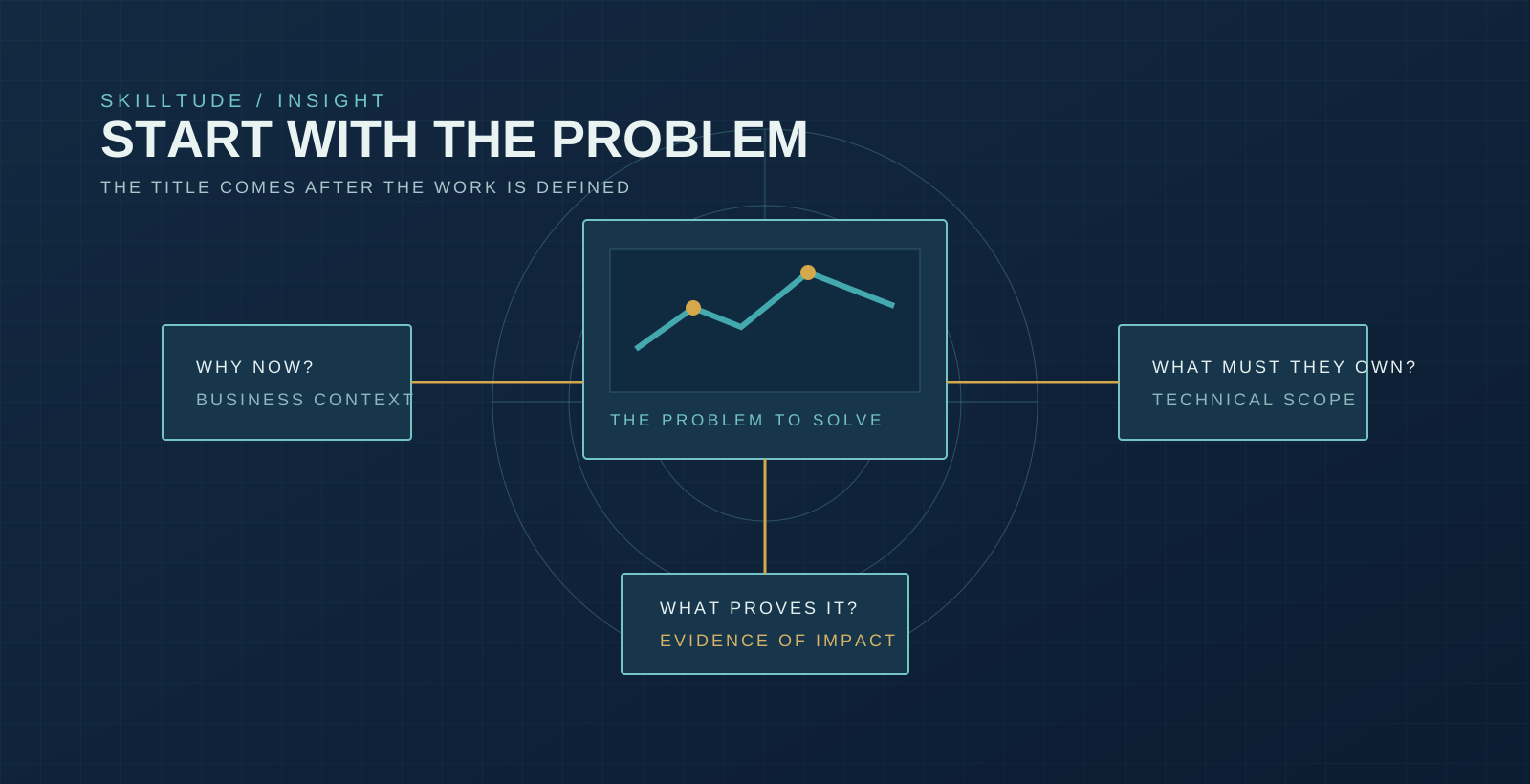
Start with the problem.
What is the company trying to build, fix or change? What will still be difficult six months after the person joins? Which decisions need to move faster? Which technical constraints are holding the team back?
Then define ownership.
The strongest briefs explain what the person will actually own rather than listing every technology they may encounter. A platform leader might own developer experience and reliability. An AI engineer might own production inference and evaluation. An engineering leader might be responsible for scaling an organisation without losing technical quality.
Once ownership is clear, the required evidence becomes easier to define.
For a senior engineer, it may be architecture decisions, systems scale and hands-on depth. For a technology leader, it may be team-building, product partnership and the ability to make decisions through ambiguity. For a security leader, it may be the combination of technical credibility and risk judgement.
This also improves candidate conversations.
Strong candidates are usually evaluating the problem as much as the opportunity. They want to understand why the role exists, what authority comes with it and whether the work is genuinely interesting.
A precise brief gives the recruiter something meaningful to discuss and gives the candidate something meaningful to evaluate.
It also improves the hiring team's decision-making.
Instead of asking whether a profile matches a title, the team can ask whether the candidate has solved comparable problems and whether their judgement fits the environment.
That is a much stronger hiring signal.
At Skilltude, this is the principle behind our search process: understand, define, map, search, evaluate, align, manage and protect the joining.
The title starts the conversation. The problem determines the search.